A Portfolio on Your Website vs a Portfolio on Lumifect
Should your project portfolio live on your own website or on Lumifect? A friendly, honest breakdown for architects, engineers, and AEC firms deciding where to host their work.
Let me be clear about what we are comparing here, because it is easy to muddle. This is not about your company website as a whole. Your website should absolutely exist for your brand, your services, and your contact page. What we are talking about is one specific thing: the portfolio itself. The gallery of projects that shows people what you have actually built.
That portfolio can live in one of two places. You can build and host it inside your own website, or you can build it on a platform like Lumifect and point people to it (or embed it right back into your site). I get asked which is better all the time, so let me walk you through it the way I would if we were sitting across a table.
First, what actually makes a good portfolio
Before we compare where it lives, let us agree on what a portfolio needs to do its job. In my experience it comes down to five things:
It shows the work clearly, with good images, drawings, and before and after views.
It keeps your name attached, so credit follows the work when it gets shared.
It is easy to keep current, because a stale portfolio quietly stops working for you.
It can be found, by clients, by employers, and by peers.
It loads fast and looks right on a phone.
Hold those five in mind. They are how we will judge each option.
Option one: a portfolio built into your own website
This is the classic route. You (or a developer) build a projects section inside your existing site. It lives on your domain, in your design, and you control every detail.
Here is the honest picture.
What is genuinely great about it: total design freedom, and it sits on your own domain with no platform in between. If you have a very particular look in mind, this is the only way to get it pixel for pixel.
What tends to go wrong: the portfolio is only as current as the last time someone touched the code. Adding a new project means editing the site, resizing images by hand, testing the layout, and deploying. Credit and attribution are whatever you remember to type in manually. And a single projects page buried inside a brochure site rarely gets found on its own, because search engines and peers are not looking there.
I have seen this pattern more times than I can count: a firm invests in a beautiful custom portfolio, launches it, and then does not touch it for two years because updating it is a small project every single time.
Option two: a portfolio built on Lumifect
Now the other route. You build the same portfolio on Lumifect, a platform made specifically for AEC and construction work.
What is genuinely great about it: the structure is already there. Images, drawings, before and after galleries, disciplines, phase, location, and credits all have a home, so you are filling in a project rather than inventing a layout. Your name stays attached automatically through built in credits, so when your work travels, your credit travels with it. Publishing a new project takes minutes, with no deploy and no broken layout to fix. And because Lumifect pages are structured for search and sit inside a discovery feed, other professionals actually come across your work.
What to be aware of: you are working within a structure rather than a blank canvas, so you trade some pixel-level design control for speed and consistency. For most people that is a trade worth making, but it is fair to name it.
Side by side, against those five needs
What a portfolio needs | On your own website | On Lumifect |
|---|---|---|
Shows the work clearly | Yes, if you build it well | Yes, structured for project work out of the box |
Keeps your name attached | Manual, easy to forget | Built in credits, automatic |
Easy to keep current | Every update is a small dev job | Publish a new project in minutes |
Can be found | Only with real SEO effort | Search-ready pages plus a discovery feed |
Fast and mobile-ready | Your responsibility to maintain | Handled by the platform |
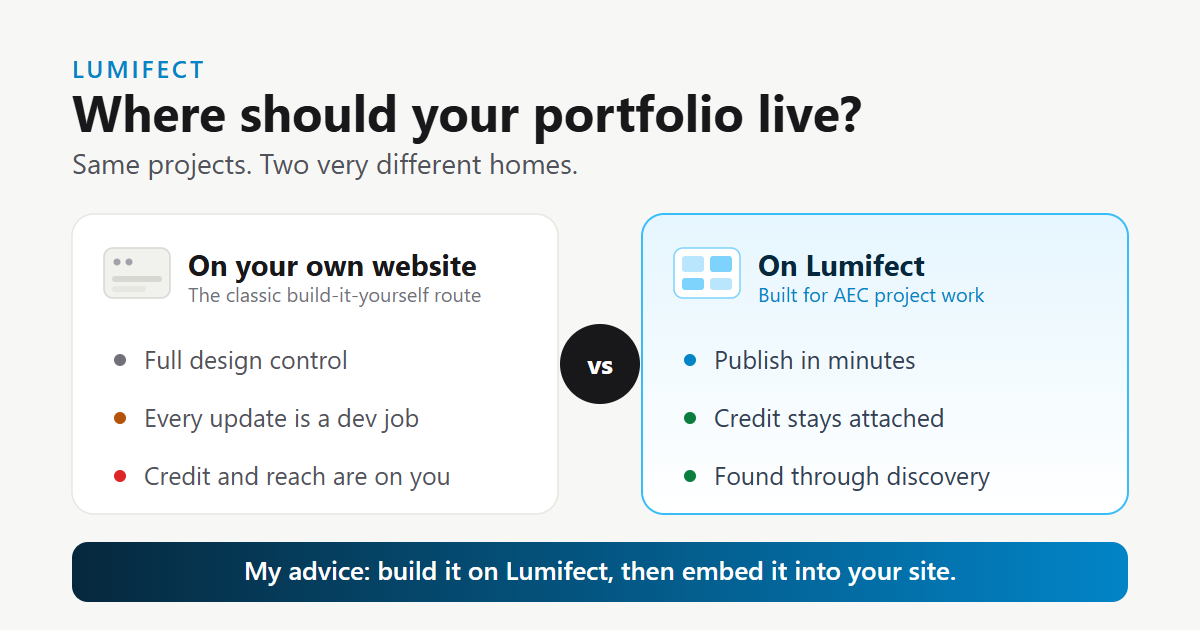
Here is what I would actually recommend
You do not have to pick a side, and honestly you should not. The move I recommend to most firms and independents is this: build your portfolio on Lumifect, then embed it back into your own website.
Think of it as one source of truth doing double duty. You maintain your projects in one place, on a platform built for exactly this. Then you embed that portfolio into your site so it shows up under your own brand, on your own domain, with none of the upkeep. Your website keeps doing its job for your brand and services. Your portfolio gets the structure, the credits, and the discoverability it needs. And when you finish a new project, you publish it once and it updates everywhere.
You get the front of a custom site and the engine of a purpose-built platform, without maintaining two portfolios.
So which should you choose?
If you have a developer on call and a strong reason to control every pixel yourself, a portfolio built into your own site can work. Just commit to keeping it current, because that is where these usually fall down.
If you want to be publishing strong project work today, stay found, and never worry about layout or upkeep, put your portfolio on Lumifect.
If you want the best of both, build it on Lumifect and embed it into your website. That is the setup I point most people toward.
Whichever you choose, the goal is the same: a portfolio that shows your work, keeps your name on it, and quietly brings you the next project. On Lumifect you can publish a portfolio built for AEC and construction work, keep your credit attached, and embed it anywhere. Start your portfolio for free.
Frequently asked questions
Is a portfolio better on my own website or on Lumifect? Both can show your work well. A portfolio on your own site gives you full design control but needs ongoing effort and its own SEO. A portfolio on Lumifect gives you structure, automatic credits, discovery, and low maintenance. For most professionals the best result is building it on Lumifect and embedding it into their own site.
Can I embed my Lumifect portfolio into my company website? Yes, and that is the setup I recommend. You build and maintain your projects on Lumifect, then embed them into your own site so the portfolio appears under your brand while the platform does the heavy lifting.
Will a portfolio page on my own website get found on Google? It can, but only with real SEO work, structured content, and good performance. A single projects page inside a broader site often struggles to rank on its own. Lumifect pages are structured for search from the start.
Do I have to choose one or the other? No. Keep your website for your brand and services, and use Lumifect as the home for your project work, embedded back into your site. That way you maintain one portfolio and it shows up everywhere.